


In this blog series, we take a look at the similarities and differences of many employee assessment instruments and how you might use them – individually and together – to achieve your business and talent development needs. For this post, we discuss the LSI™ (Life Styles Inventory) and how it compares with Whole Brain® Thinking and the HBDI®.
What is the LSI?
The LSI is a psychological assessment tool used primarily in organisational development and leadership training. Developed by Dr. J. Clayton Lafferty, the LSI is designed to help individuals understand and improve their thinking and behavioural patterns, which in turn affects their effectiveness in both personal and professional contexts.
The LSI categorises personal thinking styles into three clusters:
Constructive Styles:
- Achievement: Focuses on setting and accomplishing challenging goals.
- Self-Actualising: Emphasises self-fulfilment and personal growth.
- Humanistic-Encouraging: Involves encouraging and supporting others.
- Affiliative: Centers on building relationships and collaborating with others.
Passive/Defensive Styles:
- Approval: Seeks validation and approval from others.
- Conventional: Adheres to established norms and resists change.
- Dependent: Relies on others for guidance and decisions.
- Avoidance: Avoids responsibility and decision-making.
Aggressive/Defensive Styles:
- Oppositional: Tends to be critical, sceptical, and confrontational.
- Power: Focuses on controlling and dominating others.
- Competitive: Driven by a desire to win and outperform others.
- Perfectionistic: Strives for flawlessness, often leading to stress.
The LSI has a Self Description and an Others description. This 360-degree feedback provides an external perspective on how the individual is perceived by others.
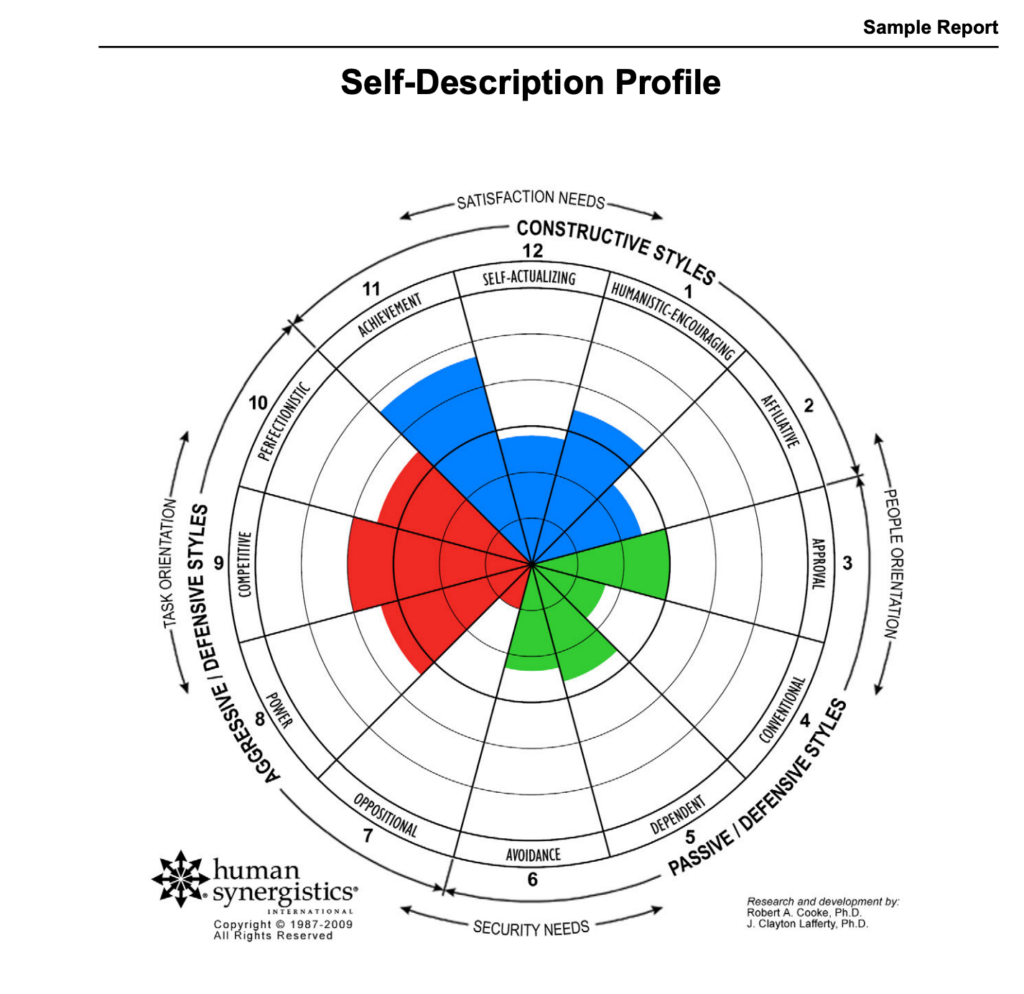
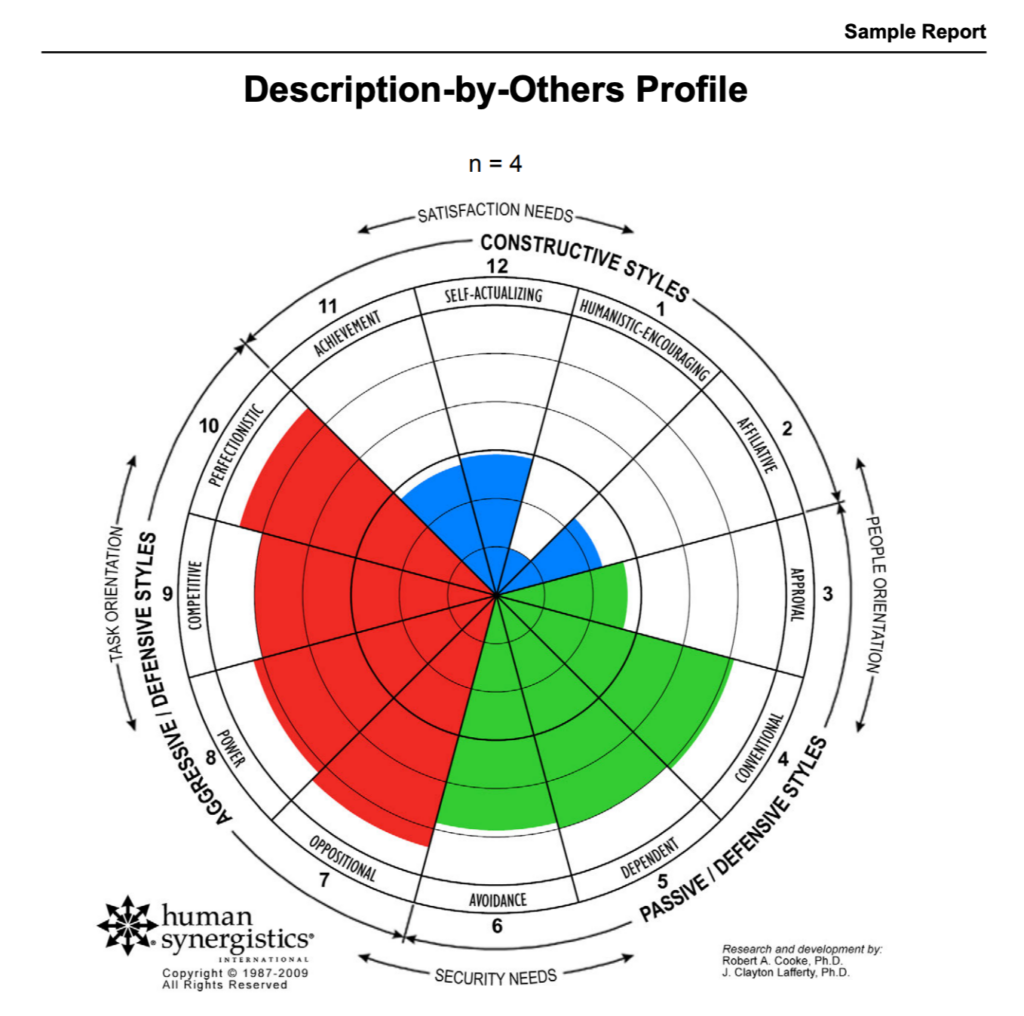
Figure: LSI Self-Description Profile and Description-by-Others Profile. Source: https://www.humansynergistics.com/wp-content/uploads/2024/01/lsi-individual-feedback-report.pdf
What is the HBDI?
The HBDI is a psychometric assessment designed to measure and describe people's thinking preferences. Developed by Ned Herrmann in the 1970s, the HBDI identifies thinking or cognitive styles. It suggests that individuals have diverse thinking preferences which can describe how they process information, solve problems, communicate and lead others.
The HBDI model divides thinking preferences into four distinct quadrants, each representing a different type of thinking. These quadrants are visualised as a circular diagram, with each quadrant representing a specific mode of thinking:
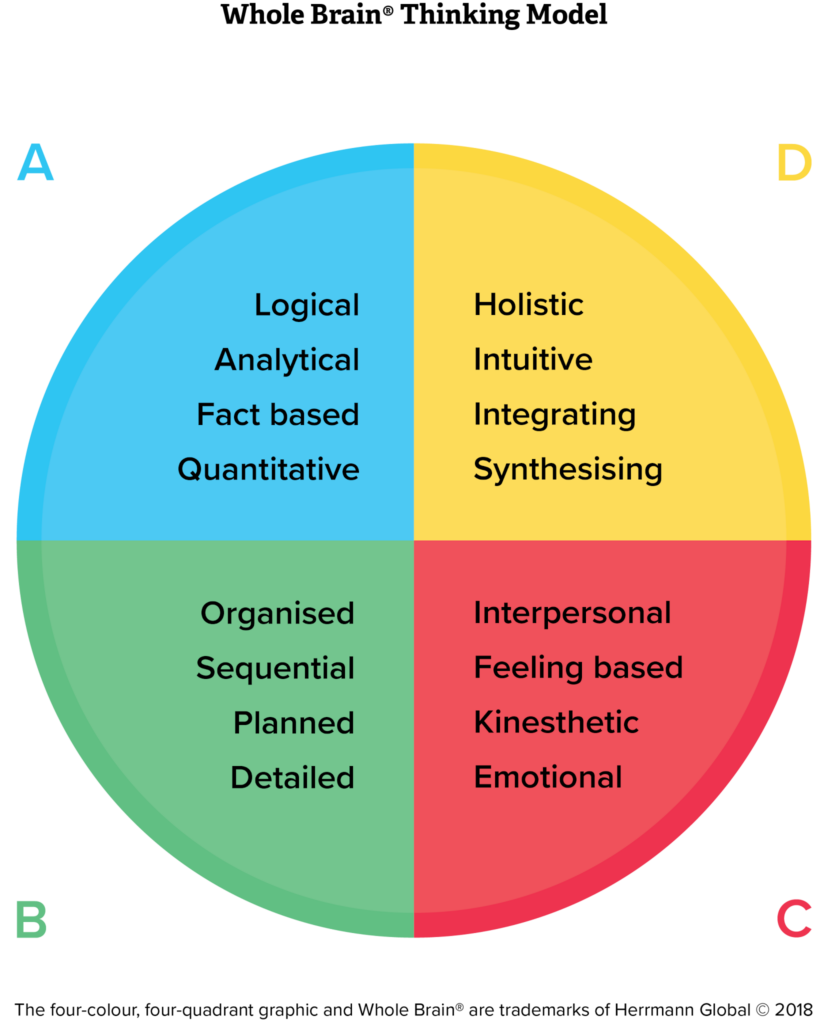
Figure: Whole Brain® Thinking Model
- A-Quadrant (Analytical Thinking):
- Focuses on logical reasoning, data analysis, and critical thinking.
- Prefers working with facts, figures, and quantitative information.
- Example activities: Problem-solving, financial analysis, technical tasks.
- B-Quadrant (Sequential Thinking):
- Emphasises organised, step-by-step, and methodical approaches.
- Prefers structure, planning, and following procedures.
- Example activities: Project management, planning, implementation.
- C-Quadrant (Interpersonal Thinking):
- Centres on emotional intelligence, empathy, and communication.
- Prefers working with people, building relationships, and collaboration.
- Example activities: Teamwork, teaching, customer service.
- D-Quadrant (Holistic Thinking):
- Involves big-picture thinking, creativity, and innovation.
- Prefers brainstorming, strategic thinking, and conceptualising ideas.
- Example activities: Strategic planning, creative design, innovation.
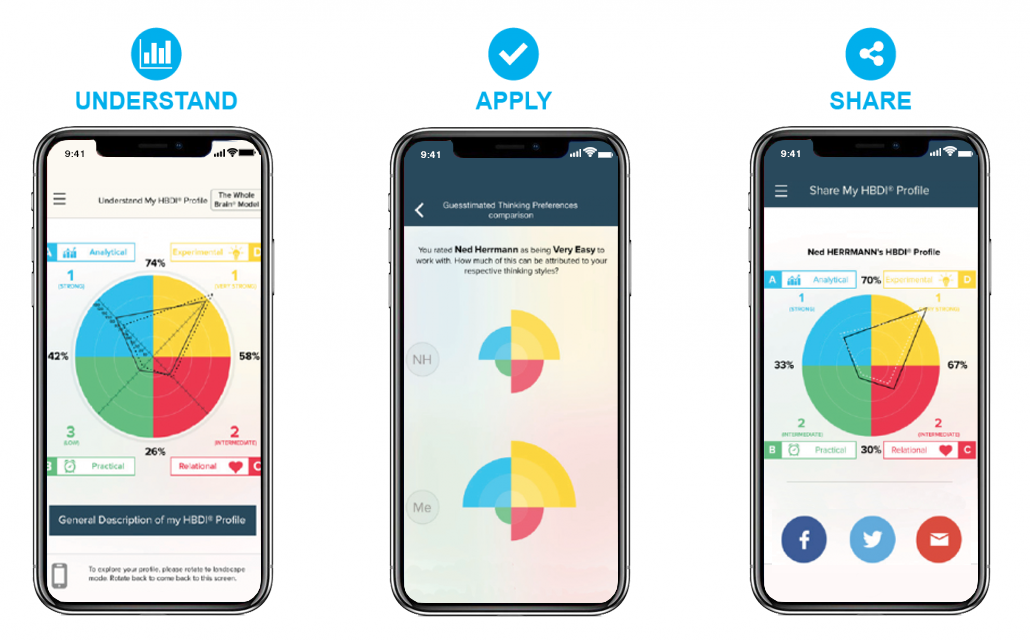
The HBDI assessment shows the relative degree of preference for each of the four Whole Brain® Thinking quadrants. This profile helps individuals understand their preferred thinking styles (they can prefer one, two, three or four styles). It also identifies areas where they might feel less comfortable or require more effort to access. It can highlight individual preferences, comparative preferences in pairs and team preferences.
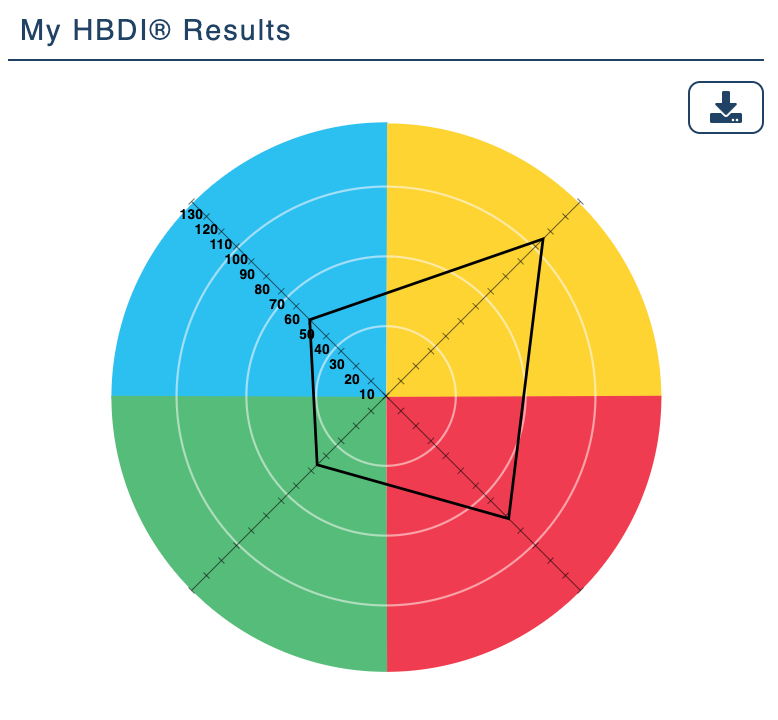
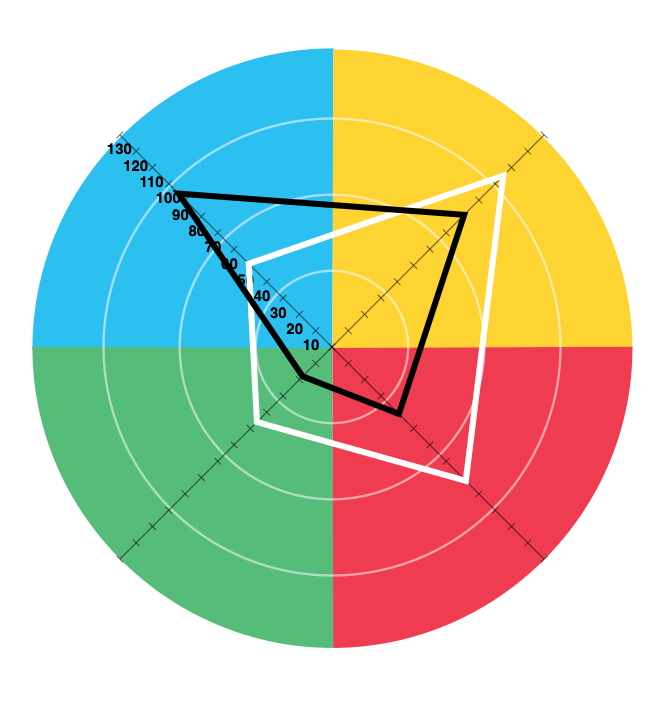
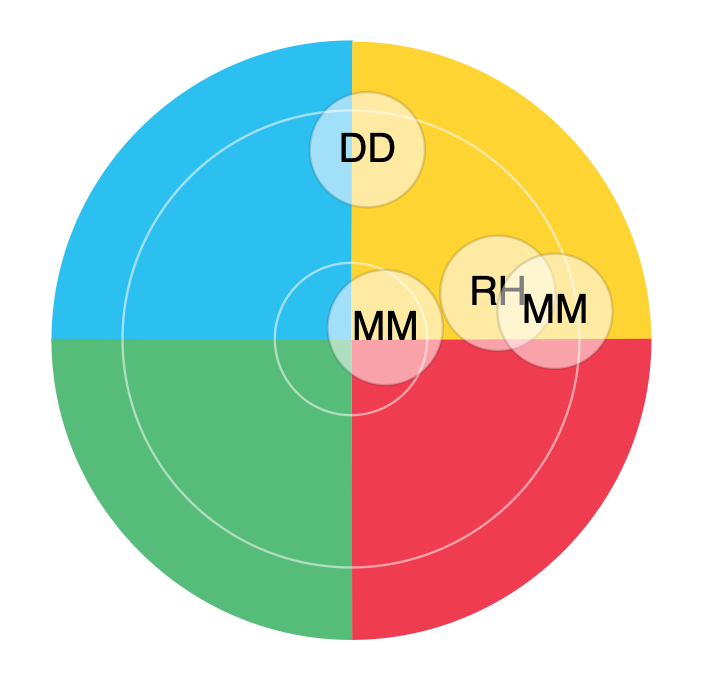
Figures: Individual HBDI preferences, comparative preferences of two people in their typical and under pressure state and a team preference map. https://herrmann.zendesk.com/hc/en-us/articles/360021406293-Accessing-and-Interpreting-the-HBDI-Reports-Samples-Included
The Whole Brain® Thinking model which sits behind the HBDI promotes the concept of Thinking Agility. This approach encourages individuals to develop and use all four quadrants of thinking, adapting their style to different situations and challenges. By understanding their own and others' thinking preferences, individuals and teams can improve communication, problem-solving, and decision-making.
Note: Although both tools use colour to differentiate their constructs. However, there is no correlation between the colours of the LSI and the HBDI constructs.
Similarities and differences between HBDI and LSI?
While both instruments operate in the space of thinking and behaviour this is where the similarities end. The HBDI identifies thinking preferences based on a degree of preference premise, meaning you have a preference for all four quadrants, importantly there is no better or worse HBDI Profile and it is not normed against a set of expectations or cultural norms.
The LSI is an instrument that norms thinking and behaviour styles which means it identifies preferred and less preferred styles. There is an ideal style in the LSI and insights into the less preferred styles help an individual set goals about future thinking and behaviours for improved success.
Although it may appear conflicting to work with employees using two different thinking styles assessments there are many complementary ways these tools can be used together. There are many Practitioners accredited in both tools who work with these complimentary tools in powerful ways.
Using the assessments as complementary tools
Using the HBDI and the Life Styles Inventory (LSI) together can provide a comprehensive understanding of an individual’s thinking and behavioural preferences, which can be incredibly valuable in personal development, leadership coaching, and team effectiveness.
Receptiveness to 360 Behavioural Feedback
Combining the HBDI and LSI can increase the receptiveness and understanding of the 360 feedback information. Use HBDI to identify an individual’s cognitive preferences. Then, map these preferences to the LSI feedback to understand how these thinking preferences translate and are perceived as helpful or unhelpful behavioural tendencies in the 360 feedback report.
For example, someone with a strong B-quadrant preference (practical, detailed) might exhibit more Passive/Defensive styles if their environment doesn’t value these traits. Similarly, someone with a strong B quadrant might exhibit Constructive Styles in the workplace. Whatever the manifestation (defensive or constructive), the HBDI Profile insights help contextualise the LSI feedback on ideal behaviour styles. The diverse thinking styles profile assessed by HBDI helps Leaders reflect on why their LSI Others Feedback may be reported in such a way.
Comprehensive Personal Development
HBDI can help individuals understand their natural thinking preferences, while LSI can help them see how these preferences manifest in their behaviour, as they move towards an ideal way of working or leading. By combining insights from both, individuals can develop more self-awareness and work on aligning their thinking with more constructive behavioural patterns.
Team Dynamics and Leadership
For leaders, using both tools can help in understanding how their thinking style (HBDI) affects their leadership behaviour (LSI). This understanding can guide them in adapting their approach to better meet the needs of their team, fostering a more constructive and effective work environment. Leaders can use the Whole Brain® Thinking approach to model effective behaviour characteristics and adopt Thinking Agility.
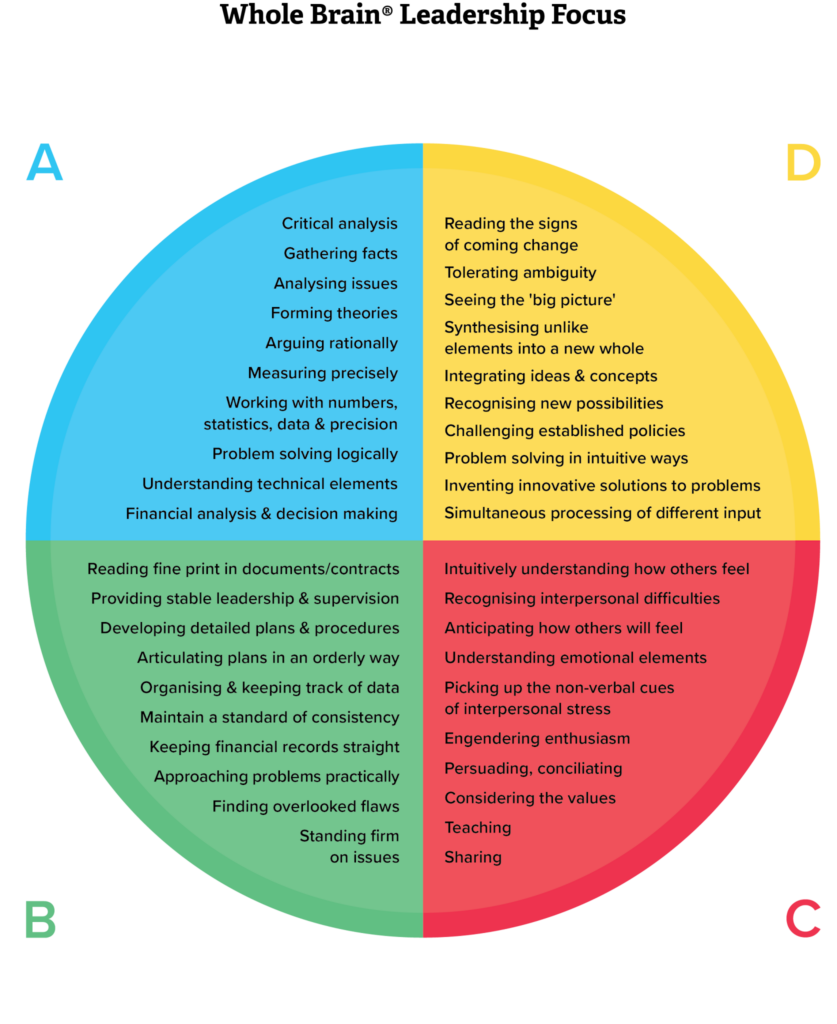
Figure: Whole Brain® Leadership Focus
Addressing Cognitive and Behavioral Gaps
The combined insights can be used to identify gaps between preferred thinking styles and actual behaviour. For instance, if a person prefers creative thinking (D-quadrant) but tends to behave in a more defensive way (Aggressive/Defensive LSI style), they can focus on developing more constructive ways to express their creativity. The HBDI is a positive-psychology approach which acknowledges that Thinking Agility is a skill we are capable of to ensure we are meeting the needs and demands of a situation. An HBDI Profile can be used to express how thinking styles can be harnessed in constructive ways. This framework can provide a strategy to improve an organisation's culture and develop more constructive behaviours and leadership. When a powerful strategy is in place, the LSI can then be used to track or measure this change within an individual.
Application in Coaching
As a coach, you can use HBDI to help clients understand their thinking preferences and LSI to assess how these preferences are influencing their behaviour. This dual approach can lead to more targeted coaching interventions, helping clients develop strategies to overcome personal challenges and enhance their effectiveness in both personal and professional contexts.
What tool should I use?
In summary, The HBDI® and the Life Styles Inventory™ (LSI) serve different purposes, so one isn’t necessarily better than the other; it depends on your goals when assessing which tool you should use.
HBDI focuses on identifying thinking preferences across four quadrants: Analytical, Practical, Experimental, and Relational. It’s designed to enhance understanding of cognitive diversity and improve communication, problem-solving, and decision-making.
LSI is aimed at personal development and organisational change, assessing thinking and behavioural styles to a normed scale, to help individuals understand how they relate to others and how they can improve their effectiveness. Both can be valuable tools in their respective areas and used together in complementary ways by a skilled Practitioner.